
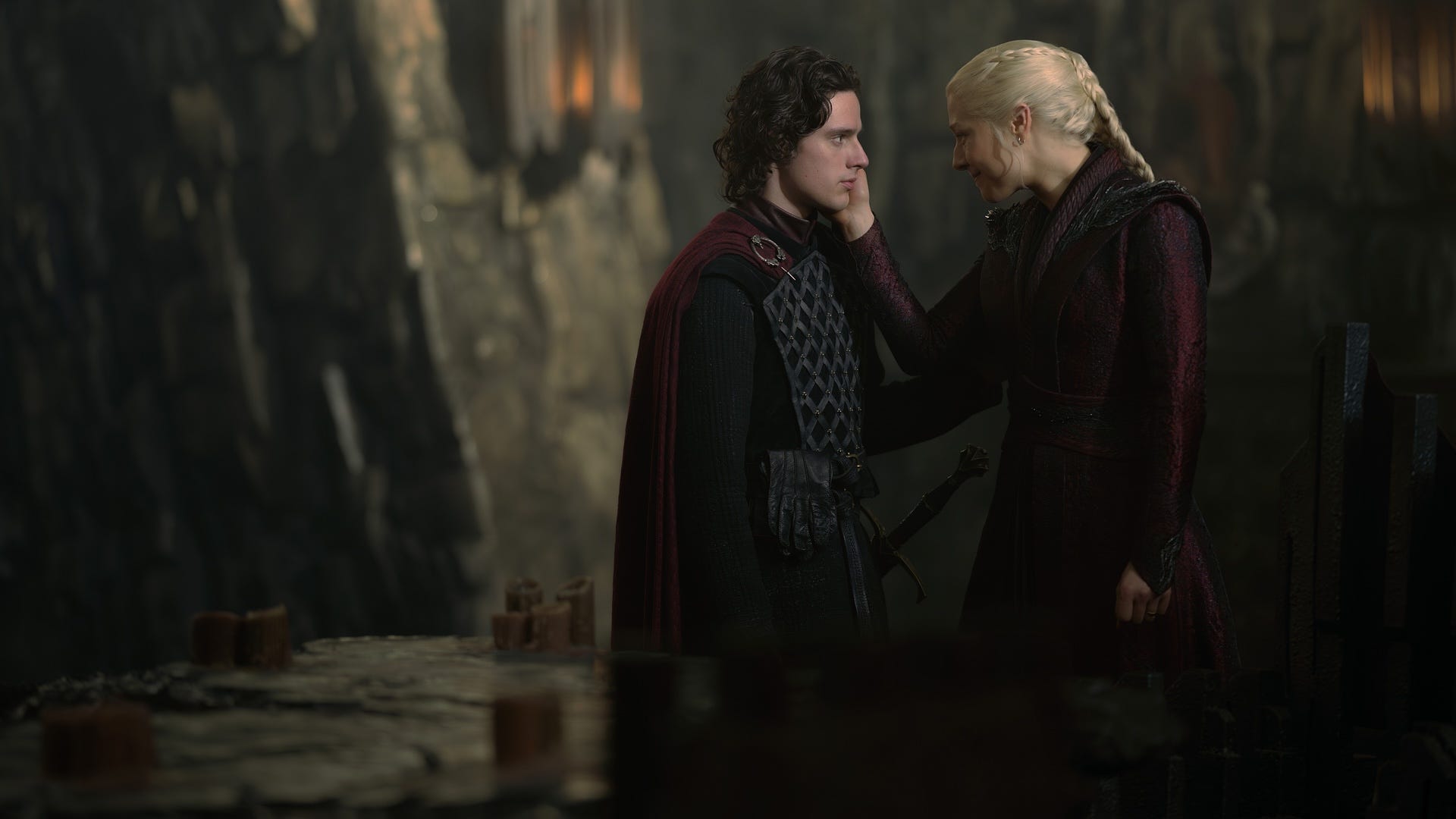
Note: The first part of this review will only talk about the TV episodes that have already aired, while the second part will discuss details from Fire & Blood, as well as other published Song of Ice and Fire books—including potential spoilers for future episodes. If you don’t want to know what’s coming, the distinction between show-only and show-and-book discussion will be clearly marked with a clip from The Simpsons.
By now, you would think we would know not to trust anything even approaching a positive or hopeful ending in the world of A Song of Ice and Fire/Game of Thrones. Anytime an episode or a season ends with so much as a hint that things might be looking up, it is an inevitability that more pain and suffering are right around the corner.
We even had a visceral reminder of this earlier this year when episode four of A Knight of the Seven Kingdoms ended with Prince Baelor announcing his support for Dunk in the Trial of Seven. The iconic “Game of Thrones” rocked the soundtrack, signalling our hero’s arrival. But by the end of the next episode, Baelor was dead. Struck down accidentally by his own brother, robbing Dunk of a powerful ally and the realm of a great king.
The use of the Thrones main theme in that moment was telling. A Knight of the Seven Kingdoms had eschewed the theme and epic opening sequences that have begun every episode of Game of Thrones and House of the Dragon since 2011, in favour of a more low-key title card at the start of every episode. The show had briefly teased the theme’s use at the start of the first episode, before memorably cutting to a poop joke.
Some initially read this moment as a shot at the other shows—and their perceived declines in quality—that Knight shares a universe with, but I always saw it as something a little more nuanced (as nuanced as a shit joke can be). It wasn’t mocking the other shows so much as signalling it was telling a different story. It wasn’t interested in the game of thrones that the noble houses play; its focus was on the plight of the smallfolk who bear the brunt of the highborn’s schemes and wars.
When the theme returned in episode four, its purpose was two-fold. In part, it served to show how Dunk’s story was now tied in with the larger game of thrones that he had previously believed he had no part in. And, it warned the audience that, despite the heroism of the moment, this is still Westeros and the good times never last very long. As Maester Aemon once put it, “The Starks are always right eventually, winter is coming.”
All of which brings us, finally, to the season three premiere of House of the Dragon, “Salt and Sea, Fire and Blood.” The main theme, along with the elaborate title sequence, is back. There is one change, however, war drums now precede the iconic theme, as though to signal the carnage to come. The game of thrones is no longer just a game, but it’s about to explode into the most brutal and hateful of wars, where dragon fights dragon, and kin fights kin.
And, once again, the promise of a hopeful future is immediately shot down.
The season two finale, “The Queen Who Ever Was,” ended the dour (and truncated) sophomore season on an optimistic note. After eight episodes of scheming, betrayal, and child murder, everything was looking up for Rhaenyra and the Blacks. She had recruited three new Dragon riders, Daemon—with a new army in tow—had finally affirmed his loyalty (post-vision quest), and a guilt-ridden Alicent had seemingly handed her King’s Landing on a silver platter. As the finale montage played, it felt as though the “right” side was going to win, and it would be far less bloody than anyone anticipated.
But that wouldn’t make for a very interesting show now, would it?
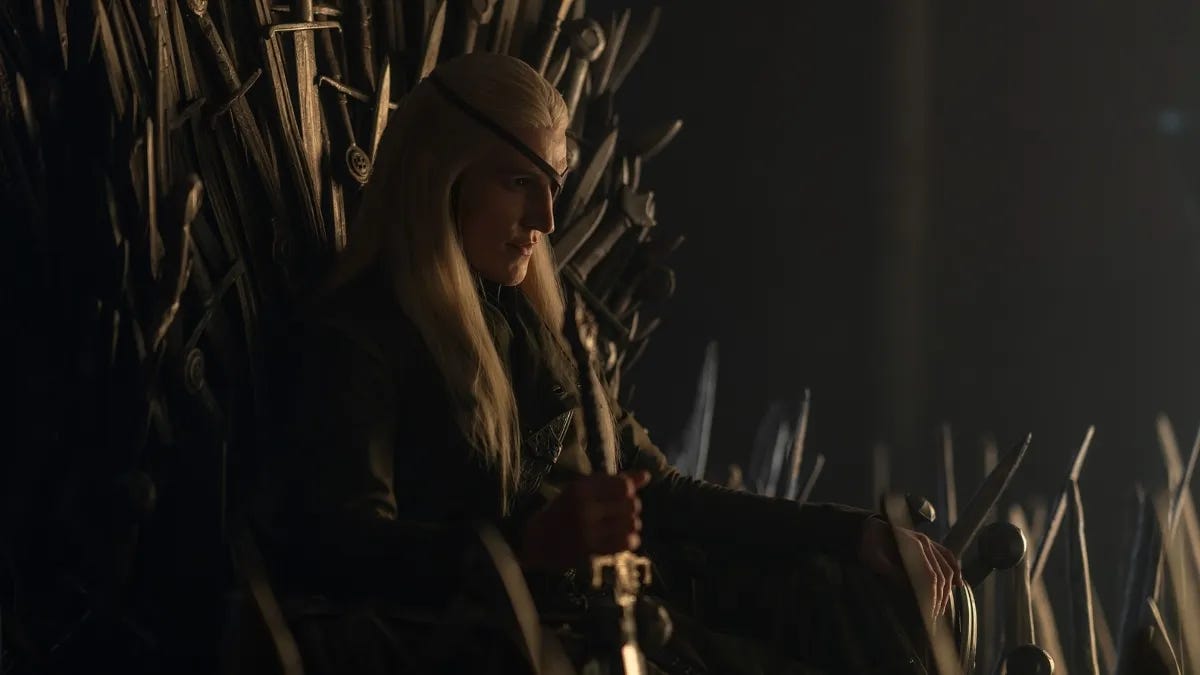
Things begin to fall apart almost immediately. Alicent has committed to sacrificing her personal legacy to save her conscience and her daughter. But when she returns to the Red Keep, Aegon has fled, and Aemond is now embracing the trappings of being royal authority on top of his powers as Prince Regent. He now sits on the Iron Throne, with a Valerian steel sword in hand, while everyone around him calls him King. What was meant to be a simple, bloodless plan to surrender the Westerosi capital to Rhaenyra is now massively complicated.
Alicent’s journey in season two was one of guilt and remorse. She was forced to grapple with how her actions had led the Seven Kingdoms to the brink of war, as well as what she truly wanted for herself and the realm. All her life, Alicent played the part that was expected of her. As a girl, she was pious and ladylike, even chaffing at Rhaenyra when she strayed from that path. She was then pushed by her father to, essentially, seduce King Viserys, eventually marrying him and bearing his children.
Her adulthood was spent trying to undermine Rhaenyra and the legitimacy of her (obviously bastard) children. But that rivalry was largely kept in check by the King. Clearly, Alicent would have rather Viserys choose one of her children as his heir, but she wasn’t plotting to undermine his wishes the way her father and his allies at court were. She only put forward Aegon as king after she misunderstood Viserys’ final words, mistaking his talk of Aegon the Conqueror for their firstborn son.
Alicent loves her children, but she is also painfully aware of who they really are. She knows Aegon is self-indulgent and suffers from imposter syndrome, causing him to make rash and careless decisions. Aemond, meanwhile, carries his childhood trauma (physical and emotional) with him everywhere he goes, leading to his ruthlessness. Neither, Alicent has come to realize, is fit to rule. This, combined with Rhaenyra’s reveal of what Viserys was actually talking about, as well as the visceral cruelty of the beginning of this war, caused her to rethink her choices and decide that Rhaenyra is her best hope for salvation. So she makes a deal, betraying her family and legacy in the name of peace.
Aegon’s disappearance puts that plan in jeopardy, however. With Aemond now embracing the trappings of a king, Alicent is forced to fall back on the scheming and plotting that made her such a formidable adversary for Rhaenyra in the first place. Only now, it’s in the service of the Queen she once sought to undermine.
But, again, this is Westeros. And when playing the game of thrones, politics alone is often not enough. There are also matters of the heart. In far and away the premiere’s most uncomfortable scene, after several tense conversations, Aemond kisses Alicent. Ice and Fire stories have never shied away from incest, but the scene is still shocking.
Alicent has always been very religious, even replacing Targaryen banners with seven-pointed stars as her influence over Viserys grew as he aged. Even though she has embraced the Targaryen family’s incestuous ways to an extent—marrying her son, Aegon, and daughter, Helaena, to each other—her faith continues to hold an important place in her life. Now, she must decide whether her commitment to Rhaenyra means putting aside her beliefs in this way, and, more importantly, potentially toying with the heart of her most broken and volatile child.
Aemond has always felt out of place; he was bullied by his older brother and his half-siblings as a child, leading to a lack of meaningful relationships in his life. This includes a lack of intimacy, to the point that when he would visit a brothel, he wasn’t having sex but cuddling. At the same time, he always believed he was better suited to ruling the Seven Kingdoms than his brother. Now, he’s grappling with the fact that power isn’t filling the vacuum left by his childhood traumas. Ruling is hard, and it’s isolating. And Aemond is grasping for anything that might provide comfort or support, be it personal or political.
The kiss is, of course, extremely uncomfortable (which is saying something for Game of Thrones). Alicent lets him believe she is giving him what he wants/needs, so that he will listen to her. It’s a ploy that works, and she gets what she wants when Aemond agrees to take Vhagar to Harrenhall, easing Rhaenyra’s path to claim the Iron Throne.
Despite her piousness, Alicent is not without sin. She has had sex out of wedlock with Cristin Cole (also violating his oaths as a Kingsguard) and used her body to acquire favours from Larys Strong. So she is not above ignoring her beliefs to get what she wants. But it’s different when it’s your son. Alicent knows Aemond’s trauma better than anyone else, and the costs of toying with her son’s heart will be high. Even putting aside what he might do, will she be able to continue to manipulate her son in the same way she has other men throughout her life? Aemond won’t take it well if he ever finds out, never mind the cost to Alicent’s soul for exploiting her son’s insecurities in this way.
In the season two finale montage, there were contrasting shots of Rhaenyra and Alicent contemplating their respective futures. Where Rhaenyra was framed in the context of history and legacy, surrounded by the scrolls telling the story of House Targaryen, Alicent stared out at an open horizon, no longer trapped by her past. Now that horizon has several dragons on it, she is left to rely on the skills that got her into this mess to get her out of it.
With all that history bearing down on Rhaenyra comes the weight of tradition, including the expectations of gender roles in Westeros. This should be nothing new to her, having spent her entire life pushing back on the expectations that come with her womanhood. Her legitimacy as heir was questioned, as her father’s allies actively plotted against her because she was a girl. Even now, surrounded by people who see her as the rightful ruler, she is expected to play a different role in the war than she might have were she a man.
Kings are expected to lead their men into battle. It was an indictment of Joffrey's leadership when he ran from the battle of Blackwater Bay in Game of Thrones. Queens, however, are expected to stay as far away from the war as possible. For a dragon rider like Rhaenyra, this is doubly insulting. And that’s before taking into account that her son is one of those keeping her from the fray.
Compare the indignity Rhaenyra faced with what happened to Aegon last season. When King Aegon decided to fly into battle despite Cristin Cole and Aemond not wanting him there, no one stopped him. He was allowed to join the fight at Rook’s Rest on dragonback (to his peril). However, when Queen Rhaenyra wanted to join the battle of the Gullett, Jace, with the support of her Queensguard, locked her in her quarters and barred her from flying into battle.
Of course, Jace’s fate proves him partially right. It is foolish for the regent or the heir to the throne to actually fight in the war. War is chaos, and you never know what might happen. While Jace’s death is the result of Sheepstealer’s unexpected arrival at the battle, there is no guarantee that he would have met a different fate without the rogue dragon’s presence. He had already almost been shot down once before, only for Baela to bail him out. (Same goes for Aegon, who nearly died at Rook’s Rest last season.)
The way the Battle of the Gullet played out, keeping Rhaenyra from the battle was probably the right choice. But it should have been based on strategy and protecting the royal bloodline, not because she’s a woman. Rhaenyra’s anger at her situation leads to an outburst from her like we haven’t seen since she was a child. She destroys a symbol of her femininity while lamenting her place in the world. Even the man over whom she had the most influence, her eldest son and heir, still falls back on traditional gender roles.
That said, Jace’s death was heartbreakingly well executed. From the fake out of having Baela save him the first time from the Triarchy’s weapons (a genius twist on the regular “Scorpion” guns), only to have it work the second time. Then the false ray of hope of him finding a wooden board to float on, seconds before being shot in the neck with an arrow. It was devastating.
The aftermath of the battle is going to be fascinating. There is, obviously, the inherent tragedy in losing Jace. But Sheepstealer and Rhaena’s unexpected arrival and their role in Jace’s death (as well as the death by friendly dragon fire of many Velaryon men) present a new wrinkle. Rhaena is also another person who disobeyed her Queen by chasing Sheepstealer through the Vale after Rhaenyra charged her with accompanying her youngest children into hiding. While she may appreciate having another Dragon in her retinue, the context in which that Dragon was gained, as well as the immediate consequences, will not please the Queen.
Aboard the ships in the epic naval battle, the story is surprisingly dry. We pick up on Corlys and Alyn’s storyline from season two. Amidst all the political intrigue and interpersonal drama taking place on Dragonstone and in King’s Landing, it’s hard to get invested in such an ordinary storyline. Steve Toussaint and Abubakar Salim are both excellent performers, and it’s because of them that there is any real interest in this storyline.
Because, at its best, that’s all it can be: ordinary. It’s a story that’s been done countless times in various media. The absentee father tries to make amends with his estranged son. At its best, Ice and Fire makes us care about the interpersonal dramas of the characters, whether or not they involve Dragons, White Walkers, or any kind of magic. But the writers haven’t figured out how to elevate this story to those heights, despite the strengths and charisma of its performers.
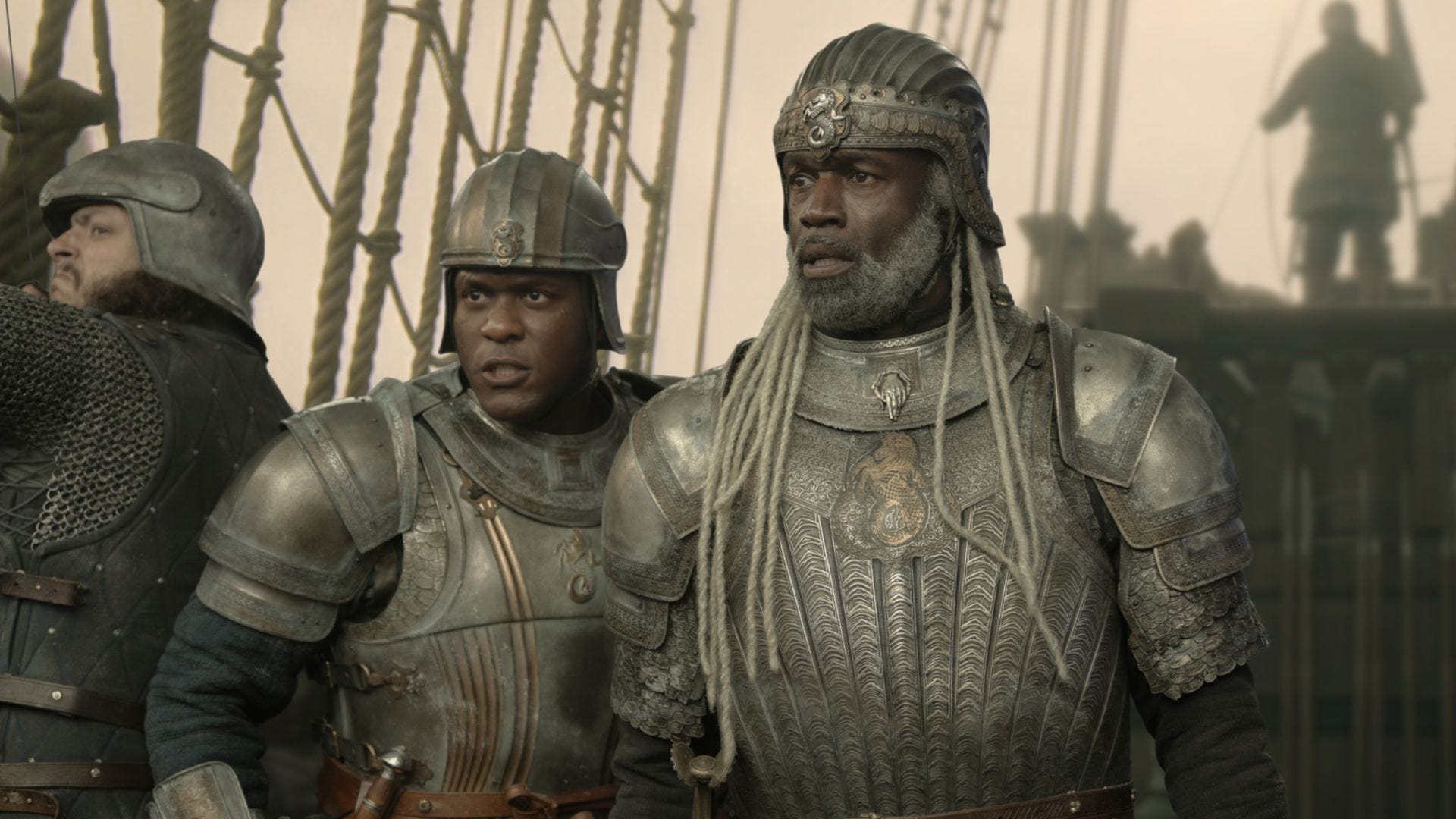
The one bit of added intrigue comes from Abigail Thorn’s pirate captain, Sharako Lohar. Lohar, we learn, has a vendetta against the Sea Snake because of the various wars he fought in the Step Stones in season one. Though she is nominally aligned with the Greens, thanks to Tyland Lannister, she has her own agenda and is quick to abandon the cause she signed on for to pursue it.
I do wish we had been introduced to this character earlier. Thorn is such a welcome presence on screen, with her flair providing a nice contrast to the seriousness of the Velaryons, and I do wish we’d had more time with her. The Step Stones stories also often felt removed from everything else in the show, becoming something of an afterthought once Daemon returned from his time there in episode two. Introducing Lohar earlier might have served to make the storyline feel more well-rounded and her defeat all the more significant in this episode.
That said, the character served their purpose admirably, forcing some of Alyn’s feelings for his father to the surface when he thought he had lost him. I know the show leaves Corlys’ fate uncertain at the end of this episode, but until proven otherwise, I am sticking with the classic “If you don’t see a body…” idiom and expecting the tense father/son bonding to continue to play out in the weeks to come.
It goes without saying that the spectacle of the battle was incredible. The team making these shows continues to one-up themselves year after year, season after season. The chase sequence with Lohar stalking the Sea Snake through that narrow, shallow passage was a thrilling and fun twist on the classic “car chase” formula.
“Salt and Sea, Fire and Blood” holds an interesting place amongst Thrones/Ice and Fire premieres. Because HBO chose to cut last season from ten episodes to eight, without allowing the final episodes to be rewritten, much of what we’ve discussed already was originally slated for the end of season two. It gives this episode an interesting cross of late-season and early-season storylines. While the events on Dragon’s Stone, King’s Landing, and in the Gullett feel like they are direct continuations from where season two left off, the other storylines are all about laying new groundwork for the rest of the season.
The scenes involving Daemon and Grover Tully, Aegon and Larys, Cristin Cole and Gwayne Hightower, Lord Ormund Hightower, and the three new Dragon riders (Ulf, Hugh, and Adam) meeting Alys Rivers all feel like they would be more at home in a classic Thrones premiere, establishing what the new storylines will be. As such, compared to the rest of the episode, there isn’t as much meat on the bone. All three are intriguing—especially what’s going on with the Dragon riders—but we’ll wait for those stories to advance a little more before diving too deeply.
Overall, the premiere delivers on many of the unfulfilled promises of last season in a fulfilling way. The twists are well executed and suggest that more action, scheming, and prophecy are on the horizon as season three plays out over the next seven weeks.
We’re now going to shift to discussing the episode in relation to the stories it’s adapting. If you don’t want to know spoilers for future episodes, stop reading now! Do not scroll past this Simpsons clip…
For as interesting as the intrigue and the drama are on screen, the behind-the-scenes of House of the Dragon is just as fascinating, thanks to the public rift between the show’s two co-creators: author George RR Martin and showrunner Ryan Condal.
Back during season one, they seemed to be on the same page, each praising the other and Condall revealing that the premiere’s most intriguing reveal (Viserys telling Rhaenyra about Aegon the Conqueror’s dream, the “song of ice and fire”) came from Martin, despite not being in any of the books. But during season two, it became clear that things between the two men weren’t so great, with Martin criticizing the show on his blog. Most recently, in a December 2025 interview, Martin described their relationship as “abysmal.”
Much of the tension stems from adaptation choices. Martin, famously, doesn’t like it when the people adapting his work make big changes to it. He resisted talking about the adaptation choices during the later seasons of Game of Thrones, likely because it likely would have spoiled what he was working on in The Winds of Winter and A Dream of Spring. But now, he doesn’t have that problem.
While Martin still plans to write a second volume of Fire and Blood, the material House of the Dragon is adapting is taken exclusively from the first volume. So, presumably, this is why he feels freed up to speak his mind more freely this time around. (Add in that, after 15 years of Game of Thrones TV shows ruling the world, he has become a bona fide celebrity in his own right and weilds far more power and influence now than he did during the original show’s run).
All this to say, the tension between Martin and Condal puts a microscope on any changes the show makes from its source material.
In some ways, Fire and Blood allows greater freedom in adaptation than most other shows/movies based on books. It’s written as an in-universe history book rather than a traditional novel, inviting many different interpretations of its events. The show has used this to great effect in building up Rhaenyra and Alicent into actual characters, rather than sketches of historical figures.
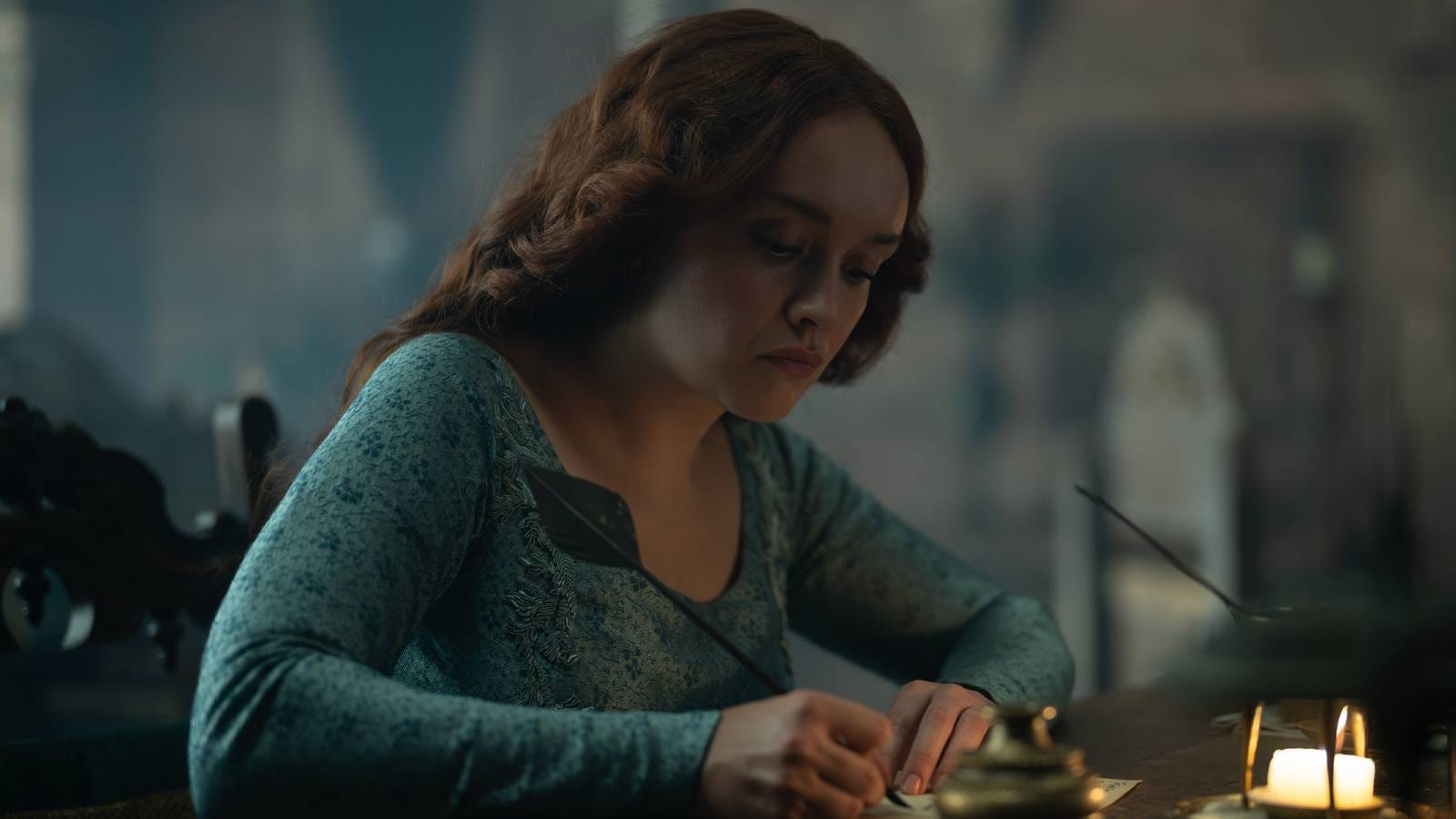
It also allows for reflection on how history remembers events compared to how they actually are. We see this particularly with Alicent, who comes across as just a villain in the book, but in the show is shown to be far more nuanced thanks to the writing and performances of Olivia Cooke and Emily Carey. The fact that she is secretly helping Rhaenyra, knowing full well she won’t get credit for it, makes her a far more interesting character.
Rhaenyra even called this out last season, telling Alicent, “History will paint you a villain.” Having read Fire and Blood, we know just how true this is. But it’s also fun to see that there is far more to it than history tells us.
But not all changes are so nuanced. Others are much more the classic case of doing something expressly different from what it says on the page, which brings us to Rhaena and Sheepstealer.
In the book, Rhaena stays in the Vale and never claims a Dragon. Instead, Sheepstealer is ridden by a lowborn girl named Nettles. From a production standpoint, I can understand why Condal and HBO might make this decision. Presumably, they already like working with Phoebe Campbell (who plays Rhaena) and want to keep her involved. Sticking with a performer you already know and like could be seen as a safer choice than casting a new actress in a new role.
That said, while I understand the reasons (and do like Rhaena on the show), I am a little leery of this choice. One of the first indications that Game of Thrones might not maintain its quality levels was when they started inserting existing characters into storylines that belonged to new characters in the books. Most infamously, Jamie and Bron’s Dornish adventures in season five. I hope this change is handled better, but I worry House of the Dragon might repeat some of Game of Thrones’ mistakes.
Similarly, I’m curious to see what’s going on with the three new Dragon riders on the Isle of Faces. While I am certainly intrigued by the prospect of digging into some of the deeper lore at play in this storyline, such a departure from the books causes me to raise an eyebrow. It’s not apples to apples with the Sheepstealer changes, but it walks a similar path.
That said, I do think the episode did a really good job laying the groundwork for Ulf’s eventual betrayal of Rhaenyra. Showing why he has a chip on his shoulder and may not be as receptive to the honours Rhaenyra wants to bestow on him as she expects was a nice bit of foreshadowing and builds well off what we saw of him last season.
I’ll also be interested to see how the show handles Hugh’s betrayal, too. It’s less clear now why he would betray his queen, seeing as he appears to be a pretty honourable guy. It will be fascinating to watch as a misread prophecy messes with his mind to the point of throwing everything he has away. It could provide a nice counterpoint to Daemon, who, last season, was led to do the right thing because of prophecy (seeing the song of Ice and Fire in a weirwood vision). Prophecy has never been an easy thing for characters to handle in this world, so having different portrayals of the ways it can change people has the potential to be a lot of fun.
I read Fire and Blood for the first time over the past few weeks, so my experience with this season will be different from the previous two. I really enjoyed looking at how A Knight of the Seven Kingdoms adapted “The Hedge Knight” earlier this year, so I was eager to recreate that experience here. (I didn’t read A Song of Ice and Fire until after Game of Thrones had passed them, so that was a new experience for me with Westeros).
Bring on the rest of the season!
https://shapeofcinema.substack.com/p/house-of-the-dragon-season-three?r=8dbojf&utm_medium=ios
My read has always been that it is exactly about politics! That, ultimately, matters of the heart are set aside. That’s why it’s so challenging and painful to watch.